


(FWA 2025/12/22)Taiwan’s labor laws and regulations have undergone significant updates in late 2025, which will be fully effective in 2026. Whether you are working in a factory, institution, or company, understanding these new regulations is essential to protecting your leave rights and salary benefits.
Part 1: New Rules on Sick Leave & Full Attendance Bonuses
(Applicable to: Workers covered by the Labor Standards Act, such as factory workers, institutional caretakers, and general office staff)
In the past, some employees faced the deduction of their entire monthly “Full Attendance Bonus” for taking just one day of sick leave. To protect workers’ rights, new regulations have been implemented to address this issue.
1. “Proportional Principle” for Bonus Deductions
Under the new regulations, if a worker takes “Ordinary Sick Leave,” the employer must calculate the deduction of the Full Attendance Bonus proportionally based on the number of days taken. The employer cannot deduct the entire bonus.
- Calculation Example:Suppose the monthly Full Attendance Bonus is **NT$3,000**, and the worker takes **1 day** of sick leave.The employer can only deduct: NT$3,000 ÷ 30 days = NT$100.
(Deducting more than the proportional amount is a violation of the law.)
2. Leave Types Exempt from Bonus Deductions
Employers cannot treat the following as absences and cannot deduct the Full Attendance Bonus for:
Personal Leave (specifically for the purpose of personally caring for family members).
Menstrual Leave.
Prenatal Check-up Leave and Pregnancy Tocolysis Leave (leave for rest due to threatened miscarriage).
Wedding Leave, Funeral Leave, and Occupational Sickness Leave.
3. Protection for Short-term Sick Leave
Regulation: A worker takes ordinary sick leave for no more than 10 days within a year.
Protection: Employers must not impose any adverse treatment (e.g., termination, demotion, salary reduction, or affecting performance appraisals) due to sick leave taken within this 10-day limit. If an employer takes such actions, they bear the burden of proof to show the punishment is unrelated to the sick leave.
4. More Flexibility for Personal Leave
If a worker needs to take Personal Leave to personally care for family members (e.g., a family member is suddenly ill), they can now choose to take leave “by the hour.” This offers greater flexibility to handle emergencies and return to work.
Part 2: Guide to Leave Rules & Specific Leave Types
(Applicable to: Workers covered by the Labor Standards Act)
The following explains how different types of leave are scheduled and how pay is calculated:
1. Regular Leave & Rest Days (Weekly Time Off)
Taiwan implements a “One Regular Leave, One Rest Day” policy. In principle, you should have 2 days off every 7 days:
Regular Leave (Example: Sunday): This is a mandatory rest day. In principle, overtime is not allowed (except in special circumstances like natural disasters).
Rest Day (Example: Saturday): If the employer has a need and the worker agrees, overtime work is permitted, but the employer must pay a higher standard of overtime pay.
2. National Holidays
Principle: There are 16 National Holidays in Taiwan per year (e.g., New Year’s Day, Lunar New Year, Labor Day, etc.). Workers should generally be off work and receive full pay.
Overtime: If a worker agrees to work on a National Holiday, the employer must pay double wages (the original daily wage + one extra day’s wage).
Voting Days: Workers with voting rights whose scheduled workday falls on an election day must be given the day off. If they work, overtime pay applies.
3. Special Leave (Annual Leave)
Days: 3 days after working for 6 months; 7 days after 1 year. Days increase with seniority.
Scheduling: The dates for Special Leave are determined by the worker. Employers may negotiate based on business needs but cannot force specific dates.
Settlement: Any unused days at the end of the year or upon contract termination must be converted to wages and paid to the worker, or deferred to the next year by mutual agreement.
4. Wedding & Funeral Leave
Wedding Leave: 8 days with full pay. Should be taken within 3 months starting from 10 days before the marriage registration.
Funeral Leave: 3 to 8 days depending on the relationship (e.g., 8 days for parents or spouse). Full pay. Can be taken in installments.
5. Sick Leave & Rights for Female Employees
Ordinary Sick Leave: Half pay for up to 30 days within a year.
Occupational Sickness Leave: Full pay (salary compensation) during the medical treatment period for injuries sustained at work (including commuting).
Menstrual Leave: Female employees can take 1 day per month. Half pay. No deduction from Full Attendance Bonus.
Maternity Leave: 56 days before and after childbirth. Full pay if employed for more than 6 months.
[Summary Table] Overview of Labor Leave Rights
(Based on the Labor Standards Act and related regulations)
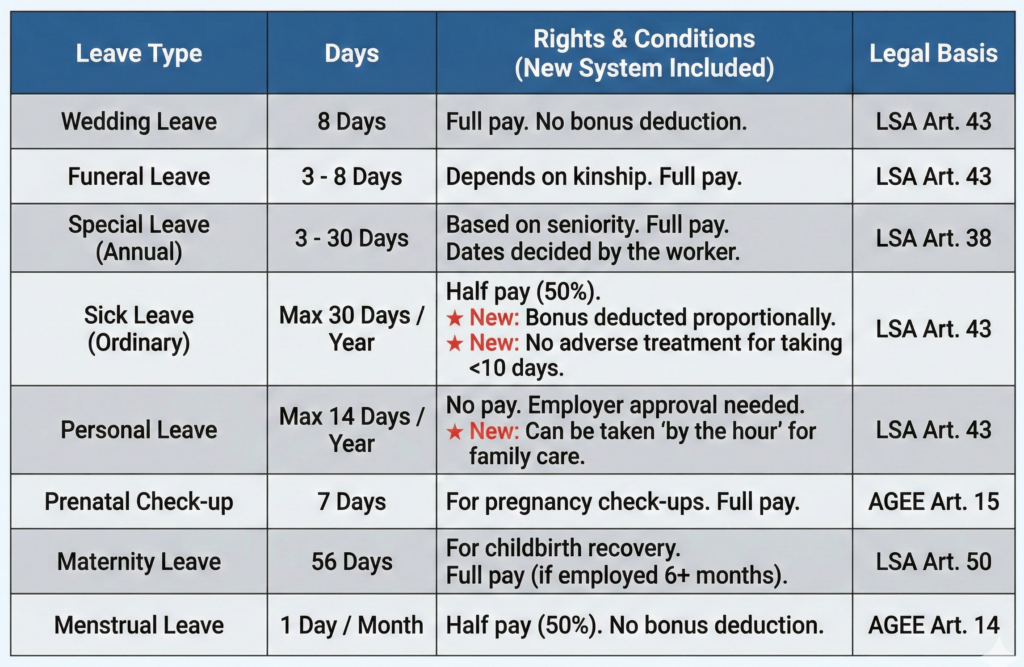
(LSA: Labor Standards Act; AGEE: Act of Gender Equality in Employment)
Part 3: Domestic Caretaker Zone
(Applicable to: Domestic Caretakers / Not covered by LSA, governed by Employment Contract)
If you work as a caretaker in a household, you are not covered by the Labor Standards Act mentioned above, but you are protected by your Labor Contract. If you wish to take leave but your employer is worried about having no one to care for the elderly, please refer to the following resources:
1. Your Right to Leave
Check Contract: According to the standard labor contracts (from Indonesia, Philippines, Vietnam, etc.), employers should generally provide at least 1 day off every 7 days.
Overtime Pay: If you agree to work on your rest day, the employer must pay overtime wages for that day.
2. Government Alternative Care Resources (Short-term & Respite Care)
The Ministry of Labor and the Ministry of Health and Welfare provide subsidies to help cover care needs when migrant workers take leave. When you are on leave, professional Taiwanese caregivers can step in.
📢 Info to Show Your Employer:
【Support for Migrant Worker Leave: Government Care Services】
Dear Employer, to improve care quality and allow your migrant caregiver to rest, you can apply for the government’s “Short-term Substitute Care Service” and “Expanded Respite Care Service.”
Service: Professional caregivers from government-contracted units/institutions.
Quota: Qualified applicants (Long-Term Care Level 2-8) can use a total of 52 days per year for both services combined.
Cost: General households are subsidized 84% by the government; low-income households are fully subsidized.
How to Apply: Please dial “1966” (Long-Term Care Helpline) for assessment and arrangement.
3. Weekend Alternative: Peer Respite Platform
If employers need a more flexible option, they can also consider the “Peer Respite Platform” (互助喘息平台).
Model: Operates on a mutual aid basis, usually providing services on Saturdays and Sundays.
Advantage: It is very affordable (approx. NT$80-100 for a half-day). Employers can exchange one session of volunteering for two sessions of service. This is a win-win solution that allows employers to get respite and migrant workers to take weekends off. Employers are encouraged to search for “Peer Respite Platform” (互助喘息平台) for more details.
Disclaimer:
Relevant regulations and determinations are subject to official announcements and explanations. This article compiles relevant information for reference only and does not constitute any professional or legal advice.